Chapter 5 – Interactions
Feynman diagrams
Richard Feynman created diagrams showing particle interactions. They have time along one axis and show particles interacting at vertices along the time line. Here is a simple diagram:
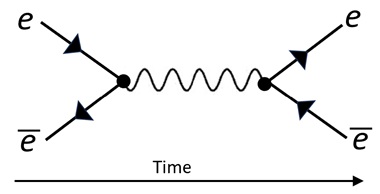
This starts with an electron and a positron (that is an anti-electron which is labeled as a with a bar over it). By convention, anti-particles have arrows going backwards.
- At the first vertex, the particles are annihilated and a photon is generated. Photons are shown with wavy lines.
- At the second vertex the photon changes to an electron and positron.
Note: The resulting particles did not exist before the interaction and are spontaneously created
Diagrams can be rotated
A rotated diagram shows an equally valid interaction. The new direction of the arrows can cause particles and anti-particles to be swapped.
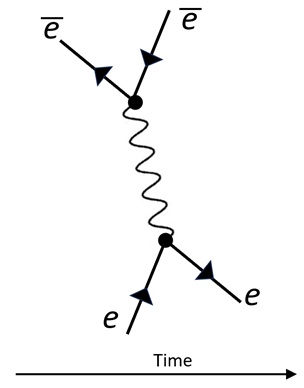
This rotated version of the last diagram describes a different interaction between an electron and a positron.
- A positron changes to a positron and a photon
- An electron absorbs the photon to give a new electron
More than just pictures
Feynman diagrams give a formal way of calculating the probability of an outcome by considering the infinite variations that achieve a result and adding them up!
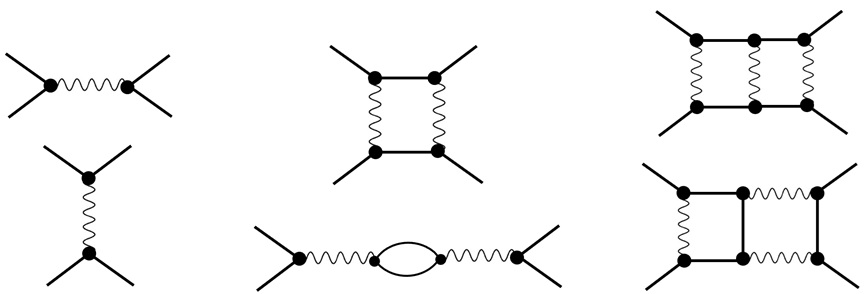
How can an infinite number of variations be added up?
Infinite series can be summed if the values go down rapidly. For exaample:
1 + 1/2 + 1/4 + 1/8 + 1/16 + ….. = 2.0
Each extra level of complexity in the Feynman diagram reduces contribution by the fine structure constant (about 1/137). To see how quickly this converged consider adding an infinite number of terms:
1 + 1/137 + 1/1372 + 1/1373 + …. = 1.00735294
If we just stop after two terms we get the answer correct to 6 decimal places:
1 + 1/137 + 1/1372 = 1.00735255
This allows the probabilities of different interactions to be calculated without really having to look at all infinite number of variations
Big Idea
Feynman diagrams are used to calculate probabilities for particle interactions