Chapter 1 – Introducing quantum mechanics
Electron energy levels
Classical physics shows that matter consists of atoms. Atoms have a nucleus made of protons and neutrons with electrons orbiting the nucleus. Protons have a positive change and each proton is balanced by an orbiting electron with negative charge
It also shows an electric charge that is moving generates a magnetic field and radiates energy.
So how are electrons able to orbit the nucleus without spiraling in?
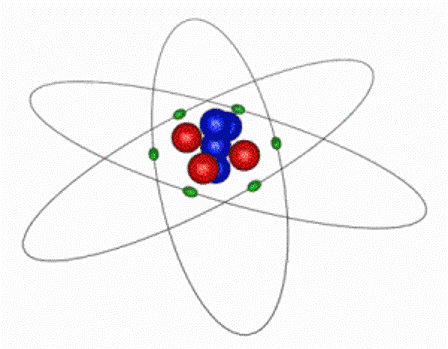
Explaining stable orbits
In 1913, Niels Bohr said the angular momentum of electrons must be a multiple of Planck’s constant. This gives discrete possible orbits.
Electrons can’t spiral in but can jump to a new orbit by emitting units of energy. This early understanding was later refined in wave mechanics.
This also explains absorption and emission spectrums from gasses that have spikes for each available orbit jump.

Big Idea
Orbiting electrons have energy in incremental amounts – energy comes in lumps!