Chapter 2 – Wave functions and uncertainty
A probabilistic world
Physicists used to assume the world was deterministic :
- Outcomes in a deterministic world can be exactly known
- Any uncertainty can be reduced with better knowledge
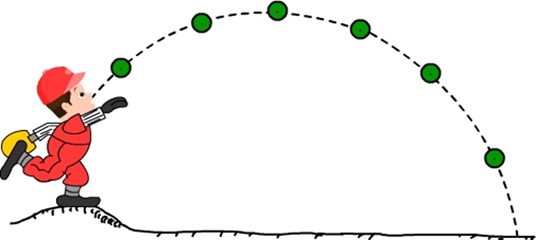
Consider throwing a baseball – we expect it to be possible to calculate exactly where it will land.
We will see that the world of quantum mechanics is not deterministic. It is probabilistic:
- Outcomes in a probabilistic world are random
- We can’t know the result until we measure it
When we don’t know exactly where something is, its position can be described by a probability distribution. Imagine a friend who left an ½ hour ago for another city – we can estimate where they are now with a probability distribution. The distribution changes and has more uncertainty after more travel time. This diagram shows what the two different probability distributions for where our friend could be at different times:

That is a one-dimensional example. A full two-dimensional drawing has the possibility of the friend taking different routes. The map shows three routes from the city on the right to the destination on the left. The red and orange areas show the high and medium probability places the friend could be after 1/2 hour. The dark and light gray areas show the possible places after 1 hour.

In a loosely similar way, a wave function describes the possible state of particles at different points in time. The probability of finding a particle at a position can be calculated from the wave function.
Schrödinger created the equation that describes exactly how the wave function for a particle evolves over time.
We will show how wave functions explain the unexpected result from the double slit experiment.
Big Idea
Wave functions essentially give the probability of finding a particle at each possible position