Chapter 1 – Introducing quantum mechanics
Matter as waves
We have seen that light can behave as a wave and as particles. We also saw that both photons and electrons can have limits to their allowable energy. Is there a connection between these discoveries?
A radical proposal
In 1924 Louis De Broglie made the radical proposal that all matter is both a wave and a particle. He specifically said particles have a wavelength proportional to 1/momentum
How can particles be waves?
Properties of particles:
- Have exact size
- Have exact position
- Have energy
- Have mass
- Have momentum (speed)
Wave can have all these properties except size and position are not exact.

We have no reason to expect particles like electrons must have an exact size and position.
Can a wave have mass?
Mass is resistance to changing speed
A large mass means something is hard to get moving and hard to stop
Waves have this property!
Can a wave have momentum?
Momentum describes how difficult something is to stop or change direction.
This image shows short and long wavelength waves shifted by the same amount

The short wavelength has changed the most – this is higher momentum, The long wavelength did not change much with the shift – this is low momentum
Momentum can exist without position so they are only indirectly related
A wave packet for a particle gives probabilities for values of its properties: position, wavelength, energy, momentum, etc.

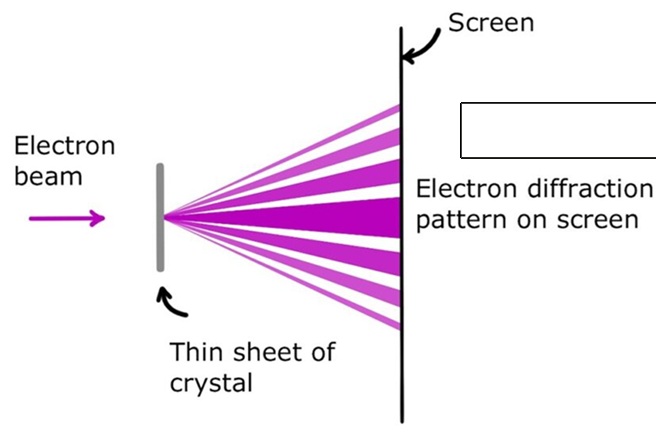
In 1927 Clinton Davisson and George Paget Thomson independently confirmed De Broglie’s theory by generating diffraction patters when electrons were fired at a crystalline structure.
Big Idea
All particles behaving like waves is a radical foundation to quantum mechanics!